
复制安装命令
用 Codex 或 Claude 安装复制这段 Prompt,粘贴到 Codex、Claude 或其他助手里,让它先审查 Skill 页面再帮你安装。
复制前请先查看来源、License 和安全提示。
Persistent memory compression system built for Claude Code .
用 Codex 或 Claude 安装复制这段 Prompt,粘贴到 Codex、Claude 或其他助手里,让它先审查 Skill 页面再帮你安装。
复制前请先查看来源、License 和安全提示。
来源文件:README.md


🇨🇳 中文 • 🇹🇼 繁體中文 • 🇯🇵 日本語 • 🇵🇹 Português • 🇧🇷 Português • 🇰🇷 한국어 • 🇪🇸 Español • 🇩🇪 Deutsch • 🇫🇷 Français • 🇮🇱 עברית • 🇸🇦 العربية • 🇷🇺 Русский • 🇵🇱 Polski • 🇨🇿 Čeština • 🇳🇱 Nederlands • 🇹🇷 Türkçe • 🇺🇦 Українська • 🇻🇳 Tiếng Việt • 🇵🇭 Tagalog • 🇮🇩 Indonesia • 🇹🇭 ไทย • 🇮🇳 हिन्दी • 🇧🇩 বাংলা • 🇵🇰 اردو • 🇷🇴 Română • 🇸🇪 Svenska • 🇮🇹 Italiano • 🇬🇷 Ελληνικά • 🇭🇺 Magyar • 🇫🇮 Suomi • 🇩🇰 Dansk • 🇳🇴 Norsk





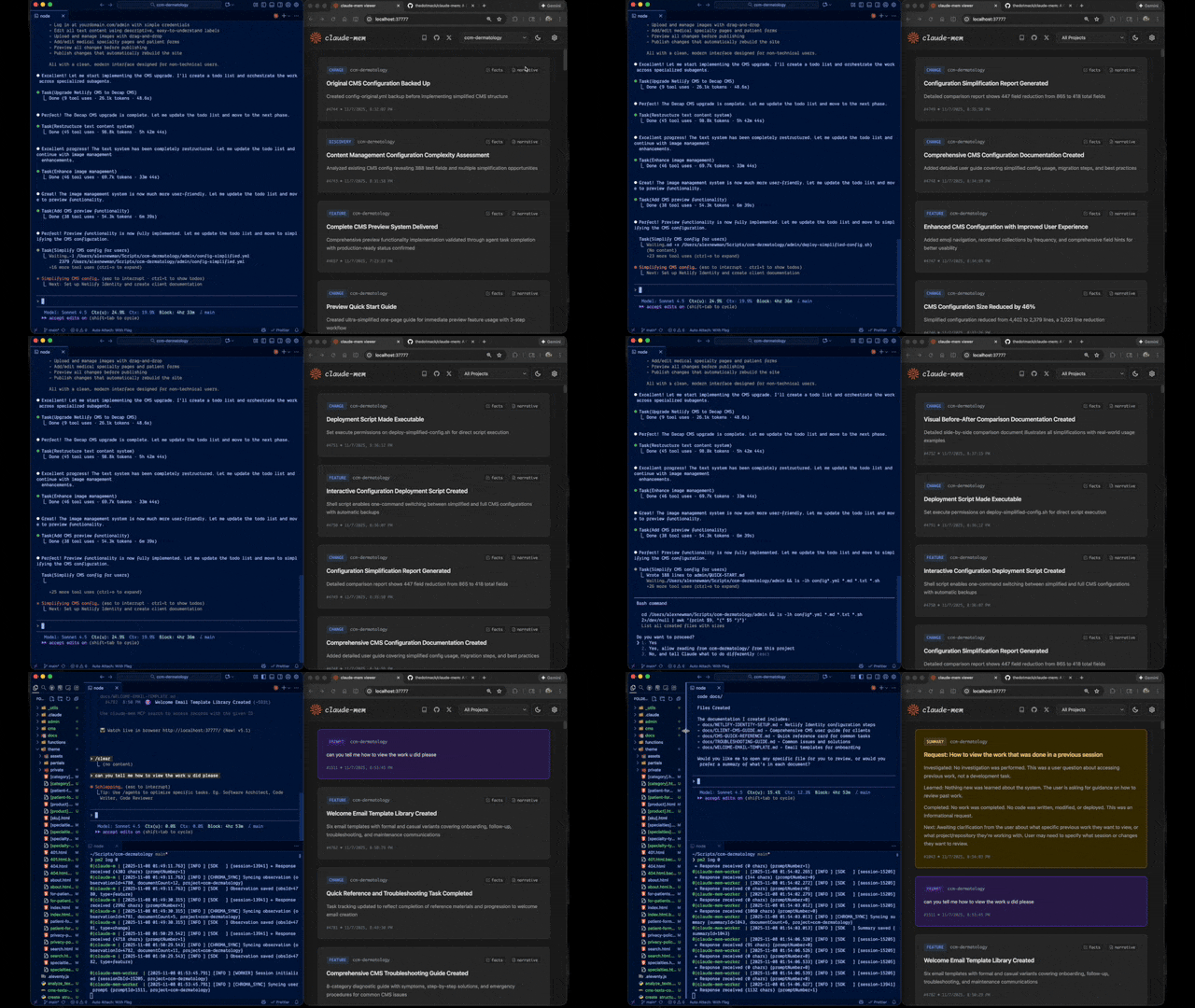
|
|
Quick Start • How It Works • Search Tools • Documentation • Configuration • Troubleshooting • License
Claude-Mem seamlessly preserves context across sessions by automatically capturing tool usage observations, generating semantic summaries, and making them available to future sessions. This enables Claude to maintain continuity of knowledge about projects even after sessions end or reconnect.
Install with a single command:
npx claude-mem install
Or install for OpenCode:
npx claude-mem install --ide opencode
Or install for Antigravity CLI (setup guide):
npx claude-mem install --ide antigravity
Or install from the plugin marketplace inside Claude Code:
/plugin marketplace add thedotmack/claude-mem

/plugin install claude-mem
Restart Claude Code. Context from previous sessions will automatically appear in new sessions.
Note: Claude-Mem is also published on npm, but
npm install -g claude-meminstalls the SDK/library only — it does not register the plugin hooks or set up the worker service. Always install vianpx claude-mem installor the/plugincommands above.
Install claude-mem as a persistent memory plugin on OpenClaw gateways with a single command:
curl -fsSL https://install.cmem.ai/openclaw.sh | bash
The installer handles dependencies, plugin setup, AI provider configuration, worker startup, and optional real-time observation feeds to Telegram, Discord, Slack, and more. See the OpenClaw Integration Guide for details.
Key Features:
<private> tags to exclude sensitive content from storage📚 View Full Documentation - Browse on official website
Core Components:
See Architecture Overview for details.
Claude-Mem provides intelligent memory search through 4 MCP tools following a token-efficient 3-layer workflow pattern:
The 3-Layer Workflow:
search - Get compact index with IDs (~50-100 tokens/result)timeline - Get chronological context around interesting resultsget_observations - Fetch full details ONLY for filtered IDs (~500-1,000 tokens/result)How It Works:
search to get an index of resultstimeline to see what was happening around specific observationsget_observations to fetch full details for relevant IDsAvailable MCP Tools:
search - Search memory index with full-text queries, filters by type/date/projecttimeline - Get chronological context around a specific observation or queryget_observations - Fetch full observation details by IDs (always batch multiple IDs)Example Usage:
// Step 1: Search for index
search(query="authentication bug", type="bugfix", limit=10)

// Step 2: Review index, identify relevant IDs (e.g., #123, #456)

// Step 3: Fetch full details
get_observations(ids=[123, 456])
See Search Tools Guide for detailed examples.
Stable releases ship from main and are published to npm. core-dev and
community-edge are source-run branches for early reliability fixes and
community integrations. See Release Branches
for the branch flow and non-stable run instructions.
If you see an error like:
npm : The term 'npm' is not recognized as the name of a cmdlet
Make sure Node.js and npm are installed and added to your PATH. Download the latest Node.js installer from https://nodejs.org and restart your terminal after installation.
Settings are managed in ~/.claude-mem/settings.json (auto-created with defaults on first run). Configure AI model, worker port, data directory, log level, and context injection settings.
See the Configuration Guide for all available settings and examples.
Claude-Mem supports multiple workflow modes and languages via the CLAUDE_MEM_MODE setting.
This option controls both:
Edit your settings file at ~/.claude-mem/settings.json:
{
  "CLAUDE_MEM_MODE": "code--zh"
}
Modes are defined in plugin/modes/. To see all available modes locally:
ls ~/.claude/plugins/marketplaces/thedotmack/plugin/modes/
| Mode | Description |
|---|---|
code | Default English mode |
code--zh | Simplified Chinese mode |
code--ja | Japanese mode |
Language-specific modes follow the pattern code--[lang] where [lang] is the ISO 639-1 language code (e.g., zh for Chinese, ja for Japanese, es for Spanish).
Note:
code--zh(Simplified Chinese) is already built-in — no additional installation or plugin update is required.
See the Development Guide for build instructions, testing, and contribution workflow.
If experiencing issues, describe the problem to Claude and the troubleshoot skill will automatically diagnose and provide fixes.
See the Troubleshooting Guide for common issues and solutions.
Create comprehensive bug reports with the automated generator:
cd ~/.claude/plugins/marketplaces/thedotmack
npm run bug-report
Contributions are welcome! Please:
Claude-Mem ships from three branches: main (stable), core-dev, and
community-edge. Only main is published to npm; the others are run from
source. See Release Branches for the
strategy and local run instructions.
See Development Guide for contribution workflow.
Claude-Mem is licensed under the Apache License 2.0.
We chose Apache-2.0 because durable agentic memory should be easy to embed in developer tools, local agents, MCP servers, enterprise systems, robotics stacks, and production agent harnesses.
See the LICENSE file for full details. See docs/license.md and docs/ip-boundary.md for licensing scope and the open/commercial boundary.
Note on Ragtime: The ragtime/ directory is licensed under the Apache License 2.0. See ragtime/LICENSE for details.
Built with Claude Agent SDK | Works with Claude Code | Made with TypeScript
CMEM is a token created by a 3rd party but officially embraced by the creator of Claude-Mem (Alex Newman, @thedotmack). The token acts as a community catalyst for growth and a vehicle for bringing CMEM to the developers and knowledge workers that need it most.
Official BASE CA: 0x76b1967eec0ccaeb001bbbb2b40dc4badba31ba3
name: mode-creator
description: Interactively create, install, activate, and verify custom claude-mem modes, including domain-specific observation types, concept tags, optional Telegram alerts, bot setup, worker restart, and startup-context verification. Use this whenever someone asks to customize what claude-mem remembers, create or change a mode, track domain-specific notes, add observation types or tags, or send Telegram notifications for particular memories—even if they do not use the word "mode."
compatibility: Requires a local claude-mem worker installation, an interactive question tool, filesystem access, and Node.js 20+. Telegram setup requires network access and a Telegram account.Create a useful note-taking system, not merely a valid JSON file. Interview the user, propose a small taxonomy, obtain approval, install it durably, configure optional alerts, restart the worker, and prove the active mode appears in startup context.
AskUserQuestion, request_user_input, or equivalent) for the interview. Ask in small batches and wait for each response.modes/ folder.CLAUDE_MEM_RUNTIME is server, explain that this workflow cannot safely install a per-user mode into the shared server and stop before mutation.Begin with this message inside the first interactive question:
Custom modes let you take notes for whatever you're working on. If you're a law student, you may want to write down every time a case establishes a rule, a professor flags an exam trap, or doctrines conflict. If you're an architect, you may want to capture every design decision, code constraint, client preference, or site discovery. What are you working on?
Do not start by asking for a mode name or JSON fields. Learn the work first.
If the answer is code-related, say:
Code mode already works well for software work. A custom variant may work better if it also tracks [2–4 specific kinds of notes inferred from their work] and tags [2–4 useful cross-cutting themes]. Would you like to keep standard code mode or customize it?
Use concrete suggestions. For an ML platform engineer, for example, suggest experiment outcomes, data-contract changes, production incidents, model decisions, cost findings, and reproducibility risks—not generic “custom notes.” If the user chooses standard code mode, do not create a redundant file; continue to the optional notification and verification steps.
Use follow-up questions to obtain:
Infer answers already present in the conversation instead of asking twice. When the user gives a broad answer, propose examples and let them select or edit them.
Read references/mode-authoring.md before drafting.
Propose:
Present the proposal in plain language and use the interactive question tool for approval. Let the user rename, add, remove, or reword categories. Do not write or install until they approve the taxonomy and privacy boundary.
Prefer an inherited ID such as code--architecture-practice so the mode reuses claude-mem's stable output protocol while replacing the domain taxonomy and behavioral prompts. The code parent is an implementation base; the override must remove code-specific semantics from the prompts. Use a standalone mode only when inheritance is genuinely unsuitable.
After the taxonomy is approved, ask:
Would you like Telegram notifications when claude-mem records any particular types or tags? Alerts include the observation type, title, subtitle, project, and observation ID, so avoid selecting categories that may expose sensitive material.
If yes:
If no, leave every Telegram setting unchanged.
Resolve the absolute directory containing this SKILL.md; all helper paths are relative to that directory.
Write the approved mode to a temporary JSON file. Use the exact inherited override shape in the authoring reference. Then validate without mutating anything:
node <skill-directory>/scripts/install-mode.mjs \
  --mode <temporary-mode.json> \
  --mode-id <parent--custom-id> \
  --dry-run
Fix every validation error before installation. Then install and activate it:
node <skill-directory>/scripts/install-mode.mjs \
  --mode <temporary-mode.json> \
  --mode-id <parent--custom-id> \
  --telegram-types <comma-separated-approved-types> \
  --telegram-concepts <comma-separated-approved-concepts>
Omit both Telegram flags when alerts were declined. The installer:
<data-dir>/modes/.CLAUDE_MEM_MODE in settings.json.Review its JSON result. Do not claim success if ok is not true.
If alerts were requested and both bot token and chat ID are already present, ask permission to reuse them and send a test. If credentials are missing, explain the BotFather steps from the Telegram reference.
Run the credential helper only after explicit consent:
node <skill-directory>/scripts/configure-telegram.mjs \
  --types <comma-separated-approved-types> \
  --concepts <comma-separated-approved-concepts>
The helper accepts the token through hidden terminal input, validates it with getMe, discovers or asks for the chat ID, sends a test message, and stores the settings with owner-only permissions. Never pass the token as an argument.
If the agent environment cannot give the user control of an interactive terminal, show the exact helper command and pause for the user to run it locally. This is the only acceptable manual boundary; do not ask them to paste the token into chat as a workaround. After they confirm, inspect only whether the credential fields are present—never print their values.
Read the configured runtime before restarting. For a worker runtime, use the verified CLI restart path:
npx claude-mem restart
npx claude-mem status
If the CLI shim is unavailable, run the installed plugin's scripts/worker-service.cjs restart with Bun. Do not use a bare restart HTTP request when the verified CLI path is available.
Verify all of the following:
settings.json names the intended CLAUDE_MEM_MODE without displaying secrets.session_start_context MCP tool when available. Otherwise call /api/context/inject?project=mode-creator-verification&full=true on the configured local worker.Mode: <mode name> (<mode id>).If the worker falls back to code, inspect the worker log for a mode validation or lookup error, repair the mode, and repeat the restart. Do not describe a fallback as successful activation.
Conclude with:
Never include the Telegram bot token in the handoff.
评论 (0)
暂无评论,成为第一个评论者吧!