
复制安装命令
用 Codex 或 Claude 安装复制这段 Prompt,粘贴到 Codex、Claude 或其他助手里,让它先审查 Skill 页面再帮你安装。
复制前请先查看来源、License 和安全提示。
Production-grade engineering skills for AI coding agents.
用 Codex 或 Claude 安装复制这段 Prompt,粘贴到 Codex、Claude 或其他助手里,让它先审查 Skill 页面再帮你安装。
复制前请先查看来源、License 和安全提示。
来源文件:README.md
Production-grade engineering skills for AI coding agents.
Skills encode the workflows, quality gates, and best practices that senior engineers use when building software. These ones are packaged so AI agents follow them consistently across every phase of development.
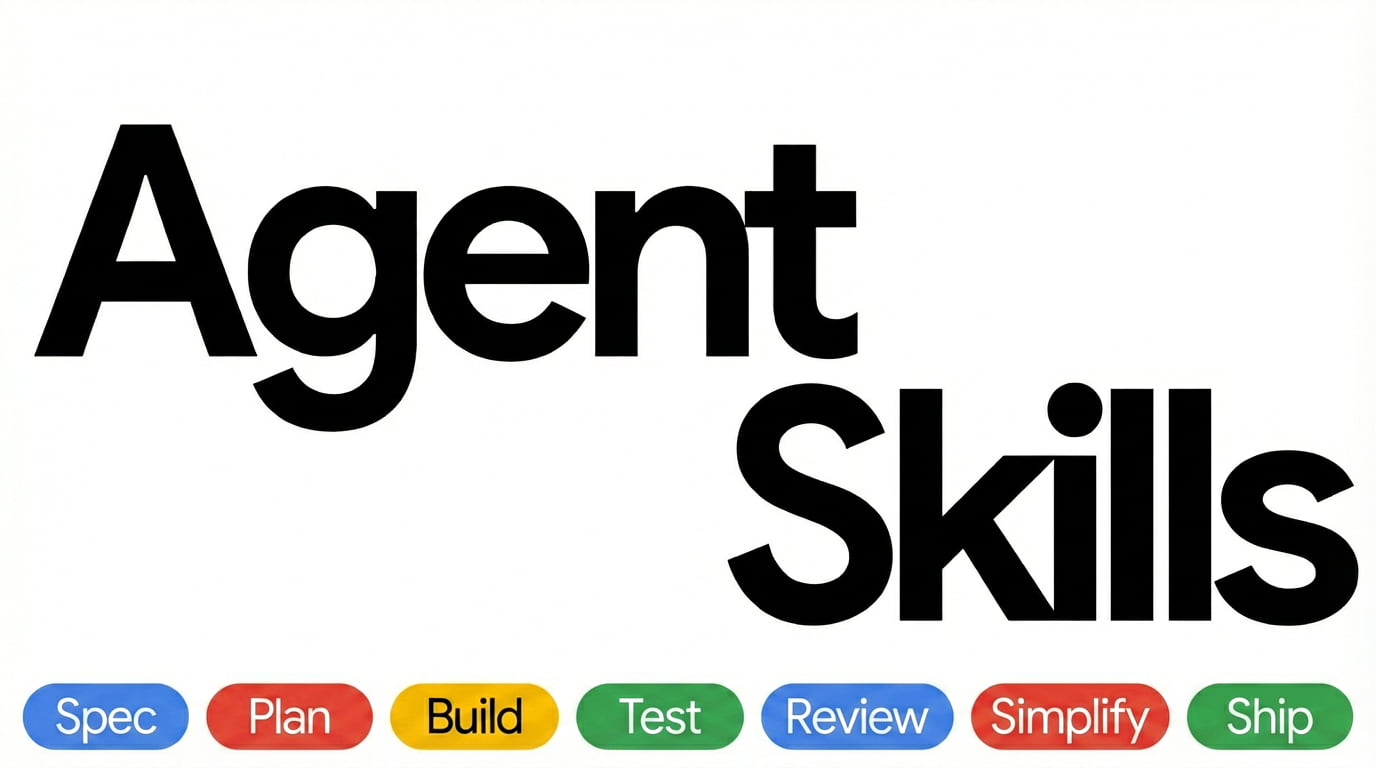
  DEFINE          PLAN           BUILD          VERIFY         REVIEW          SHIP
 ┌──────┐      ┌──────┐      ┌──────┐      ┌──────┐      ┌──────┐      ┌──────┐
 │ Idea │ ───▶ │ Spec │ ───▶ │ Code │ ───▶ │ Test │ ───▶ │  QA  │ ───▶ │  Go  │
 │Refine│      │  PRD │      │ Impl │      │Debug │      │ Gate │      │ Live │
 └──────┘      └──────┘      └──────┘      └──────┘      └──────┘      └──────┘
  /spec          /plan          /build        /test         /review       /ship
8 slash commands that map to the development lifecycle. Each one activates the right skills automatically.
| What you're doing | Command | Key principle |
|---|---|---|
| Define what to build | /spec | Spec before code |
| Plan how to build it | /plan | Small, atomic tasks |
| Build incrementally | /build | One slice at a time |
| Prove it works | /test | Tests are proof |
| Review before merge | /review | Improve code health |
| Audit web performance | /webperf | Measure before you optimize |
| Simplify the code | /code-simplify | Clarity over cleverness |
| Ship to production | /ship | Faster is safer |
Want fewer manual steps once the spec exists? /build auto generates the plan and implements every task in a single approved pass — you approve the plan once, then it runs autonomously. It removes the human stepping between tasks, not the verification: every task is still test-driven and committed individually, and it pauses on failures or risky steps.
Skills also activate automatically based on what you're doing — designing an API triggers api-and-interface-design, building UI triggers frontend-ui-engineering, and so on.
Fastest path — any agent, one command. The open skills CLI installs into 70+ agents (Claude Code, Cursor, Codex, Copilot, Cline, and more):
npx skills add addyosmani/agent-skills            # install all 24 skills
npx skills add addyosmani/agent-skills --list     # browse before installing
Or grab individual skills:
npx skills add addyosmani/agent-skills --skill code-review-and-quality   # five-axis review before merge
npx skills add addyosmani/agent-skills --skill interview-me              # requirements interrogation, one question at a time
npx skills add addyosmani/agent-skills --skill test-driven-development   # red-green-refactor, enforced
Prefer a native integration? Pick your tool below.
Marketplace install:
/plugin marketplace add addyosmani/agent-skills
/plugin install agent-skills@addy-agent-skills
SSH errors? The marketplace clones repos via SSH. If you don't have SSH keys set up on GitHub, either add your SSH key or use the full HTTPS URL to force HTTPS cloning during the marketplace-add step:
/plugin marketplace add https://github.com/addyosmani/agent-skills.git
/plugin install agent-skills@addy-agent-skills
If
/plugin installstill fails withgit@github.com: Permission denied (publickey)on Windows or macOS, the recommended workaround is to configure Git once to rewrite GitHub SSH URLs to HTTPS for subprocess clones:git config --global url."https://github.com/".insteadOf git@github.com:
Local / development:
git clone https://github.com/addyosmani/agent-skills.git
claude --plugin-dir /path/to/agent-skills
Put workflow skills under .cursor/skills/ (sync from agent-skills/skills/) and short policies in .cursor/rules/*.mdc — do not paste full skills into rules. See docs/cursor-setup.md.
Install as a native plugin for skills, subagents, and slash commands. See docs/antigravity-setup.md.
Install from the repo:
agy plugin install https://github.com/addyosmani/agent-skills.git
Install from a local clone:
git clone https://github.com/addyosmani/agent-skills.git
agy plugin install ./agent-skills
Install as native skills for auto-discovery, or add to GEMINI.md for persistent context. See docs/gemini-cli-setup.md.
Install from the repo:
gemini skills install https://github.com/addyosmani/agent-skills.git --path skills
Install from a local clone:
gemini skills install ./agent-skills/skills/
Add skill contents to your Windsurf rules configuration. See docs/windsurf-setup.md.
Uses agent-driven skill execution via AGENTS.md and the skill tool.
Use agent definitions from agents/ as Copilot personas and skill content in .github/copilot-instructions.md. See docs/copilot-setup.md.
Install as a native Codex plugin (Codex CLI v0.122+):
codex plugin marketplace add addyosmani/agent-skills
Codex reads the root skills/ directory directly through .codex-plugin/plugin.json. Once installed, invoke skills in chat using @ (e.g., @spec-driven-development). See docs/codex-setup.md for local installation and troubleshooting.
Skills are plain Markdown - they work with any agent that accepts system prompts or instruction files. See docs/getting-started.md.
Already installed? How you roll the pack out depends on your codebase. The Adoption Guide covers two paths: the full lifecycle from day one for a greenfield project, or an incremental, verification-first rollout for an established codebase.
The commands above are entry points. The pack includes 24 skills total — 23 lifecycle skills plus the using-agent-skills meta-skill. Each skill is a structured workflow with steps, verification gates, and anti-rationalization tables. You can also reference any skill directly.
| Skill | What It Does | Use When |
|---|---|---|
| using-agent-skills | Maps incoming work to the right skill workflow and defines shared operating rules | Starting a session or deciding which skill applies |
| Skill | What It Does | Use When |
|---|---|---|
| interview-me | One-question-at-a-time interview that extracts what the user actually wants instead of what they think they should want, until ~95% confidence | The ask is underspecified, or the user invokes "interview me" / "grill me" |
| idea-refine | Structured divergent/convergent thinking to turn vague ideas into concrete proposals | You have a rough concept that needs exploration |
| spec-driven-development | Write a PRD covering objectives, commands, structure, code style, testing, and boundaries before any code | Starting a new project, feature, or significant change |
| Skill | What It Does | Use When |
|---|---|---|
| planning-and-task-breakdown | Decompose specs into small, verifiable tasks with acceptance criteria and dependency ordering | You have a spec and need implementable units |
| Skill | What It Does | Use When |
|---|---|---|
| incremental-implementation | Thin vertical slices - implement, test, verify, commit. Feature flags, safe defaults, rollback-friendly changes | Any change touching more than one file |
| test-driven-development | Red-Green-Refactor, test pyramid (80/15/5), test sizes, DAMP over DRY, Beyonce Rule, browser testing | Implementing logic, fixing bugs, or changing behavior |
| context-engineering | Feed agents the right information at the right time - rules files, context packing, MCP integrations | Starting a session, switching tasks, or when output quality drops |
| source-driven-development | Ground every framework decision in official documentation - verify, cite sources, flag what's unverified | You want authoritative, source-cited code for any framework or library |
| doubt-driven-development | Adversarial fresh-context review of every non-trivial decision in-flight - CLAIM → EXTRACT → DOUBT → RECONCILE → STOP, with optional user-authorized cross-model escalation | Stakes are high (production, security, irreversible), working in unfamiliar code, or a confident output is cheaper to verify now than to debug later |
| frontend-ui-engineering | Component architecture, design systems, state management, responsive design, WCAG 2.1 AA accessibility | Building or modifying user-facing interfaces |
| api-and-interface-design | Contract-first design, Hyrum's Law, One-Version Rule, error semantics, boundary validation | Designing APIs, module boundaries, or public interfaces |
| Skill | What It Does | Use When |
|---|---|---|
| browser-testing-with-devtools | Chrome DevTools MCP for live runtime data - DOM inspection, console logs, network traces, performance profiling | Building or debugging anything that runs in a browser |
| debugging-and-error-recovery | Five-step triage: reproduce, localize, reduce, fix, guard. Stop-the-line rule, safe fallbacks | Tests fail, builds break, or behavior is unexpected |
| Skill | What It Does | Use When |
|---|---|---|
| code-review-and-quality | Five-axis review, change sizing (~100 lines), severity labels (Nit/Optional/FYI), review speed norms, splitting strategies | Before merging any change |
| code-simplification | Chesterton's Fence, Rule of 500, reduce complexity while preserving exact behavior | Code works but is harder to read or maintain than it should be |
| security-and-hardening | OWASP Top 10 prevention, auth patterns, secrets management, dependency auditing, three-tier boundary system | Handling user input, auth, data storage, or external integrations |
| performance-optimization | Measure-first approach - Core Web Vitals targets, profiling workflows, bundle analysis, anti-pattern detection | Performance requirements exist or you suspect regressions |
| Skill | What It Does | Use When |
|---|---|---|
| git-workflow-and-versioning | Trunk-based development, atomic commits, change sizing (~100 lines), the commit-as-save-point pattern | Making any code change (always) |
| ci-cd-and-automation | Shift Left, Faster is Safer, feature flags, quality gate pipelines, failure feedback loops | Setting up or modifying build and deploy pipelines |
| deprecation-and-migration | Code-as-liability mindset, compulsory vs advisory deprecation, migration patterns, zombie code removal | Removing old systems, migrating users, or sunsetting features |
| documentation-and-adrs | Architecture Decision Records, API docs, inline documentation standards - document the why | Making architectural decisions, changing APIs, or shipping features |
| observability-and-instrumentation | Structured logging, RED metrics, OpenTelemetry tracing, symptom-based alerting - instrument as you build | Adding telemetry, or shipping anything that runs in production |
| shipping-and-launch | Pre-launch checklists, feature flag lifecycle, staged rollouts, rollback procedures, monitoring setup | Preparing to deploy to production |
Pre-configured specialist personas for targeted reviews:
| Agent | Role | Perspective |
|---|---|---|
| code-reviewer | Senior Staff Engineer | Five-axis code review with "would a staff engineer approve this?" standard |
| test-engineer | QA Specialist | Test strategy, coverage analysis, and the Prove-It pattern |
| security-auditor | Security Engineer | Vulnerability detection, threat modeling, OWASP assessment |
| web-performance-auditor | Web Performance Engineer | Core Web Vitals audit with Quick/Deep modes and a metric-honesty rule; run it via /webperf |
See docs/agents.md for the decision matrix, orchestration rules, and how personas compose with skills and slash commands.
Quick-reference material that skills pull in when needed:
| Reference | Covers |
|---|---|
| definition-of-done.md | Project-wide standing bar every change clears, contrasted with per-task acceptance criteria |
| testing-patterns.md | Test structure, naming, mocking, React/API/E2E examples, anti-patterns (JavaScript/TypeScript) |
| security-checklist.md | Pre-commit checks, auth, input validation, headers, CORS, OWASP Top 10 |
| performance-checklist.md | Core Web Vitals targets, frontend/backend checklists, measurement commands |
| accessibility-checklist.md | Keyboard nav, screen readers, visual design, ARIA, testing tools |
| observability-checklist.md | On-call questions, structured logging, RED/USE metrics, tracing, symptom-based alerting, pre-launch gate |
| orchestration-patterns.md | Endorsed multi-persona orchestration patterns, anti-patterns, and the "personas don't invoke personas" rule |
Every skill follows a consistent anatomy:
┌─────────────────────────────────────────────────┐
│  SKILL.md                                       │
│                                                 │
│  ┌─ Frontmatter ─────────────────────────────┐  │
│  │ name: lowercase-hyphen-name               │  │
│  │ description: Guides agents through [task].│  │
│  │              Use when…                    │  │
│  └───────────────────────────────────────────┘  │
│  Overview         → What this skill does        │
│  When to Use      → Triggering conditions       │
│  Process          → Step-by-step workflow       │
│  Rationalizations → Excuses + rebuttals         │
│  Red Flags        → Signs something's wrong     │
│  Verification     → Evidence requirements       │
└─────────────────────────────────────────────────┘
Key design choices:
SKILL.md is the entry point. Supporting references load only when needed, keeping token usage minimal.agent-skills/
├── skills/ # 24 skills (23 lifecycle + 1 meta)
│ ├── interview-me/ # Define
│ ├── idea-refine/ # Define
│ ├── spec-driven-development/ # Define
│ ├── planning-and-task-breakdown/ # Plan
│ ├── incremental-implementation/ # Build
│ ├── context-engineering/ # Build
│ ├── source-driven-development/ # Build
│ ├── doubt-driven-development/ # Build
│ ├── frontend-ui-engineering/ # Build
│ ├── test-driven-development/ # Build
│ ├── api-and-interface-design/ # Build
│ ├── browser-testing-with-devtools/ # Verify
│ ├── debugging-and-error-recovery/ # Verify
│ ├── code-review-and-quality/ # Review
│ ├── code-simplification/ # Review
│ ├── security-and-hardening/ # Review
│ ├── performance-optimization/ # Review
│ ├── git-workflow-and-versioning/ # Ship
│ ├── ci-cd-and-automation/ # Ship
│ ├── deprecation-and-migration/ # Ship
│ ├── documentation-and-adrs/ # Ship
│ ├── observability-and-instrumentation/ # Ship
│ ├── shipping-and-launch/ # Ship
│ └── using-agent-skills/ # Meta: how to use this pack
├── agents/ # 4 specialist personas
├── references/ # 7 supplementary checklists
├── hooks/ # Session lifecycle hooks
├── .claude/commands/ # 8 slash commands (Claude Code)
├── .gemini/commands/ # 8 slash commands (Gemini CLI)
├── commands/ # 8 slash commands (Antigravity CLI)
├── plugin.json # Antigravity plugin manifest
└── docs/ # Setup guides per tool
AI coding agents default to the shortest path - which often means skipping specs, tests, security reviews, and the practices that make software reliable. Agent Skills gives agents structured workflows that enforce the same discipline senior engineers bring to production code.
Each skill encodes hard-won engineering judgment: when to write a spec, what to test, how to review, and when to ship. These aren't generic prompts - they're the kind of opinionated, process-driven workflows that separate production-quality work from prototype-quality work.
Skills bake in best practices from Google's engineering culture — including concepts from Software Engineering at Google and Google's engineering practices guide. You'll find Hyrum's Law in API design, the Beyonce Rule and test pyramid in testing, change sizing and review speed norms in code review, Chesterton's Fence in simplification, trunk-based development in git workflow, Shift Left and feature flags in CI/CD, and a dedicated deprecation skill treating code as a liability. These aren't abstract principles — they're embedded directly into the step-by-step workflows agents follow.
Wondering how this stacks up against Superpowers or Matt Pocock's skills? See docs/comparison.md for an honest, side-by-side look at how the three are shaped differently and when to reach for each — including a link to a controlled head-to-head experiment.
Skills should be specific (actionable steps, not vague advice), verifiable (clear exit criteria with evidence requirements), battle-tested (based on real workflows), and minimal (only what's needed to guide the agent).
See docs/skill-anatomy.md for the format specification and CONTRIBUTING.md for guidelines.
agent-skills is built and maintained by:
| Name | GitHub | Role | |
|---|---|---|---|
 | Addy Osmani | @addyosmani | Creator |
 | Federico Bartoli | @federicobartoli | Collaborator |
 | Joan León | @nucliweb | Collaborator |
MIT - use these skills in your projects, teams, and tools.
name: security-and-hardening
description: Hardens code against vulnerabilities. Use when handling user input, authentication, data storage, or external integrations. Use when building any feature that accepts untrusted data, manages user sessions, or interacts with third-party services.Security-first development practices for web applications. Treat every external input as hostile, every secret as sacred, and every authorization check as mandatory. Security isn't a phase — it's a constraint on every line of code that touches user data, authentication, or external systems.
Controls bolted on without a threat model are guesses. Before hardening, spend five minutes thinking like an attacker:
| Threat | Ask | Typical mitigation |
|---|---|---|
| Spoofing | Can someone impersonate a user/service? | Authentication, signature verification |
| Tampering | Can data be altered in transit or at rest? | Integrity checks, parameterized queries, HTTPS |
| Repudiation | Can an action be denied later? | Audit logging of security events |
| Information disclosure | Can data leak? | Encryption, field allowlists, generic errors |
| Denial of service | Can it be overwhelmed? | Rate limiting, input size caps, timeouts |
| Elevation of privilege | Can a user gain rights they shouldn't? | Authorization checks, least privilege |
If you can't name the trust boundaries for a feature, you're not ready to secure it. This is OWASP A04: Insecure Design — most breaches begin in design, not code.
eval() or innerHTML with user-provided dataThese are prevention patterns, not a ranking. For the 2021 ordering, see the quick-reference table in references/security-checklist.md.
// BAD: SQL injection via string concatenation
const query = `SELECT * FROM users WHERE id = '${userId}'`;

// GOOD: Parameterized query
const user = await db.query('SELECT * FROM users WHERE id = $1', [userId]);

// GOOD: ORM with parameterized input
const user = await prisma.user.findUnique({ where: { id: userId } });
// Password hashing
import { hash, compare } from 'bcrypt';

const SALT_ROUNDS = 12;
const hashedPassword = await hash(plaintext, SALT_ROUNDS);
const isValid = await compare(plaintext, hashedPassword);

// Session management
app.use(session({
  secret: process.env.SESSION_SECRET,  // From environment, not code
  resave: false,
  saveUninitialized: false,
  cookie: {
    httpOnly: true,     // Not accessible via JavaScript
    secure: true,       // HTTPS only
    sameSite: 'lax',    // CSRF protection
    maxAge: 24 * 60 * 60 * 1000,  // 24 hours
  },
}));
// BAD: Rendering user input as HTML
element.innerHTML = userInput;

// GOOD: Use framework auto-escaping (React does this by default)
return <div>{userInput}</div>;

// If you MUST render HTML, sanitize first
import DOMPurify from 'dompurify';
const clean = DOMPurify.sanitize(userInput);
// Always check authorization, not just authentication
app.patch('/api/tasks/:id', authenticate, async (req, res) => {
  const task = await taskService.findById(req.params.id);

  // Check that the authenticated user owns this resource
  if (task.ownerId !== req.user.id) {
    return res.status(403).json({
      error: { code: 'FORBIDDEN', message: 'Not authorized to modify this task' }
    });
  }

  // Proceed with update
  const updated = await taskService.update(req.params.id, req.body);
  return res.json(updated);
});
// Security headers (use helmet for Express)
import helmet from 'helmet';
app.use(helmet());

// Content Security Policy
app.use(helmet.contentSecurityPolicy({
  directives: {
    defaultSrc: ["'self'"],
    scriptSrc: ["'self'"],
    styleSrc: ["'self'", "'unsafe-inline'"],  // Tighten if possible
    imgSrc: ["'self'", 'data:', 'https:'],
    connectSrc: ["'self'"],
  },
}));

// CORS — restrict to known origins
app.use(cors({
  origin: process.env.ALLOWED_ORIGINS?.split(',') || 'http://localhost:3000',
  credentials: true,
}));
// Never return sensitive fields in API responses
function sanitizeUser(user: UserRecord): PublicUser {
  const { passwordHash, resetToken, ...publicFields } = user;
  return publicFields;
}

// Use environment variables for secrets
const API_KEY = process.env.STRIPE_API_KEY;
if (!API_KEY) throw new Error('STRIPE_API_KEY not configured');
Any time the server fetches a URL the user influenced — webhooks, "import from URL", image proxies, link previews — an attacker can aim it at internal services (cloud metadata, localhost, private IPs).
// BAD: fetch whatever the user gives you
await fetch(req.body.webhookUrl);

// GOOD: allowlist scheme + host, reject if ANY resolved IP is private, forbid redirects
import { lookup } from 'node:dns/promises';
import ipaddr from 'ipaddr.js';

const ALLOWED_HOSTS = new Set(['hooks.example.com']);

async function assertSafeUrl(raw: string): Promise<URL> {
  const url = new URL(raw);
  if (url.protocol !== 'https:') throw new Error('https only');
  if (!ALLOWED_HOSTS.has(url.hostname)) throw new Error('host not allowed');
  // Resolve ALL records; a single private/reserved address fails the check.
  const addrs = await lookup(url.hostname, { all: true });
  if (addrs.some((a) => ipaddr.parse(a.address).range() !== 'unicast')) {
    throw new Error('private/reserved IP');
  }
  return url;
}

await fetch(await assertSafeUrl(req.body.webhookUrl), { redirect: 'error' });
The range() !== 'unicast' check covers loopback, link-local 169.254.169.254 (cloud metadata, the #1 SSRF target), private, and unique-local ranges across IPv4 and IPv6.
Caveat — this still has a TOCTOU gap. fetch resolves DNS again after the check, so an attacker using a short-TTL record can rebind to an internal IP between validation and connection. For high-risk surfaces, resolve once and connect to the pinned IP, or put a filtering agent in front (request-filtering-agent / ssrf-req-filter).
import { z } from 'zod';

const CreateTaskSchema = z.object({
  title: z.string().min(1).max(200).trim(),
  description: z.string().max(2000).optional(),
  priority: z.enum(['low', 'medium', 'high']).default('medium'),
  dueDate: z.string().datetime().optional(),
});

// Validate at the route handler
app.post('/api/tasks', async (req, res) => {
  const result = CreateTaskSchema.safeParse(req.body);
  if (!result.success) {
    return res.status(422).json({
      error: {
        code: 'VALIDATION_ERROR',
        message: 'Invalid input',
        details: result.error.flatten(),
      },
    });
  }
  // result.data is now typed and validated
  const task = await taskService.create(result.data);
  return res.status(201).json(task);
});
// Restrict file types and sizes
const ALLOWED_TYPES = ['image/jpeg', 'image/png', 'image/webp'];
const MAX_SIZE = 5 * 1024 * 1024; // 5MB

function validateUpload(file: UploadedFile) {
  if (!ALLOWED_TYPES.includes(file.mimetype)) {
    throw new ValidationError('File type not allowed');
  }
  if (file.size > MAX_SIZE) {
    throw new ValidationError('File too large (max 5MB)');
  }
  // Don't trust the file extension — check magic bytes if critical
}
Package-manager audits report known advisories; they do not prove a package is trustworthy or that vulnerable code is reachable. Use this decision tree:
The native package-manager audit reports a vulnerability
├── Severity: critical or high
│   ├── Is the vulnerable code reachable in runtime, build, test, or deployment paths?
│   │   ├── YES --> Fix immediately (update, patch, or replace the dependency)
│   │   └── NO (confirmed unused across those paths) --> Fix soon, but not a blocker
│   └── Is a fix available?
│       ├── YES --> Update to the patched version
│       └── NO --> Check for workarounds, consider replacing the dependency, or add to allowlist with a review date
├── Severity: moderate
│   ├── Reachable in production? --> Fix in the next release cycle
│   └── Dev-only? --> Fix when convenient, track in backlog
└── Severity: low
    └── Track and fix during regular dependency updates
Key questions:
When you defer a fix, document the reason and set a review date.
Do not assume npm or treat the nearest manifest as the install root. Apply this order:
packageManager (when present), the lockfile, and CI; stop on disagreement or competing lockfiles. Pin the manager version and use the matrix in references/security-checklist.md.Audits only find known advisories; they do not catch a newly malicious or typosquatted package. Therefore:
npm audit fix --force or equivalent). Preview the remediation, read changelogs, and test each resulting upgrade; forced fixes may cross declared dependency ranges.npm audit signatures, pnpm audit signatures) and treat absence as a signal to investigate, not automatic proof of compromise.cross-env vs crossenv (OWASP A06, LLM03).import rateLimit from 'express-rate-limit';
// General API rate limit
app.use('/api/', rateLimit({
windowMs: 15 * 60 * 1000, // 15 minutes
max: 100, // 100 requests per window
standardHeaders: true,
legacyHeaders: false,
}));
// Stricter limit for auth endpoints
app.use('/api/auth/', rateLimit({
windowMs: 15 * 60 * 1000,
max: 10, // 10 attempts per 15 minutes
}));
.env files:
  ├── .env.example  → Committed (template with placeholder values)
  ├── .env          → NOT committed (contains real secrets)
  └── .env.local    → NOT committed (local overrides)

.gitignore must include:
  .env
  .env.local
  .env.*.local
  *.pem
  *.key
Always check before committing:
# Check for accidentally staged secrets
git diff --cached | grep -i "password\|secret\|api_key\|token"
If a secret is ever committed, rotate it. Deleting the line or rewriting history is not enough — assume it's compromised the moment it reaches a remote. Revoke and reissue the key first, then purge it from history.
If your app calls an LLM — chatbots, summarizers, agents, RAG — it inherits a new attack surface. Map it to the OWASP Top 10 for LLM Applications (2025):
eval, SQL, a shell, innerHTML, or a file path. Validate and encode it exactly as you would raw user input.// BAD: trusting model output as a command or as markup
const sql = await llm.generate(`Write SQL for: ${userQuestion}`);
await db.query(sql); // arbitrary query execution
container.innerHTML = await llm.reply(userMessage); // stored XSS, via the model
// GOOD: model output is data — parse defensively, then validate, then encode
let intent;
try {
intent = CommandSchema.parse(JSON.parse(await llm.replyJson(userMessage)));
} catch {
throw new ValidationError('unexpected model output'); // JSON.parse or schema failed
}
await runAllowlistedAction(intent.action, intent.params);
container.textContent = await llm.reply(userMessage);
### Authentication
- [ ] Passwords hashed with bcrypt/scrypt/argon2 (salt rounds ≥ 12)
- [ ] Session tokens are httpOnly, secure, sameSite
- [ ] Login has rate limiting
- [ ] Password reset tokens expire

### Authorization
- [ ] Every endpoint checks user permissions
- [ ] Users can only access their own resources
- [ ] Admin actions require admin role verification

### Input
- [ ] All user input validated at the boundary
- [ ] SQL queries are parameterized
- [ ] HTML output is encoded/escaped
- [ ] Server-side URL fetches are allowlisted (no SSRF to internal services)

### Data
- [ ] No secrets in code or version control
- [ ] Sensitive fields excluded from API responses
- [ ] PII encrypted at rest (if applicable)

### Infrastructure
- [ ] Security headers configured (CSP, HSTS, etc.)
- [ ] CORS restricted to known origins
- [ ] Dependencies audited for vulnerabilities
- [ ] Error messages don't expose internals

### Supply Chain
- [ ] One authoritative lockfile committed; CI uses that manager's frozen/immutable install
- [ ] Native audit triaged by reachability and fix risk; dependency install scripts blocked unless explicitly approved
- [ ] New dependencies reviewed (ownership, provenance, release age, transitive graph)

### AI / LLM (if used)
- [ ] Model output treated as untrusted (no eval/SQL/innerHTML/shell)
- [ ] Secrets and other users' data kept out of prompts
- [ ] Tool/agent permissions scoped; destructive actions require confirmation
For detailed security checklists and pre-commit verification steps, see references/security-checklist.md.
| Rationalization | Reality |
|---|---|
| "This is an internal tool, security doesn't matter" | Internal tools get compromised. Attackers target the weakest link. |
| "We'll add security later" | Security retrofitting is 10x harder than building it in. Add it now. |
| "No one would try to exploit this" | Automated scanners will find it. Security by obscurity is not security. |
| "The framework handles security" | Frameworks provide tools, not guarantees. You still need to use them correctly. |
| "It's just a prototype" | Prototypes become production. Security habits from day one. |
| "Threat modeling is overkill here" | Five minutes of "how would I attack this?" prevents the design flaws no control can patch later. |
| "It's just LLM output, it's only text" | That "text" can be a SQL statement, a script tag, or a shell command. Treat it like any untrusted input. |
| "The audit passed, so the dependency is safe" | Audits match known advisories. They do not detect a newly malicious package or make unreviewed install scripts safe to execute. |
*) originsevalAfter implementing security-relevant code:
评论 (0)
暂无评论,成为第一个评论者吧!