复制安装命令
用 Codex 或 Claude 安装复制这段 Prompt,粘贴到 Codex、Claude 或其他助手里,让它先审查 Skill 页面再帮你安装。
复制前请先查看来源、License 和安全提示。
A unified desktop application for managing AI coding assistant skills.
用 Codex 或 Claude 安装复制这段 Prompt,粘贴到 Codex、Claude 或其他助手里,让它先审查 Skill 页面再帮你安装。
复制前请先查看来源、License 和安全提示。
来源文件:README.md
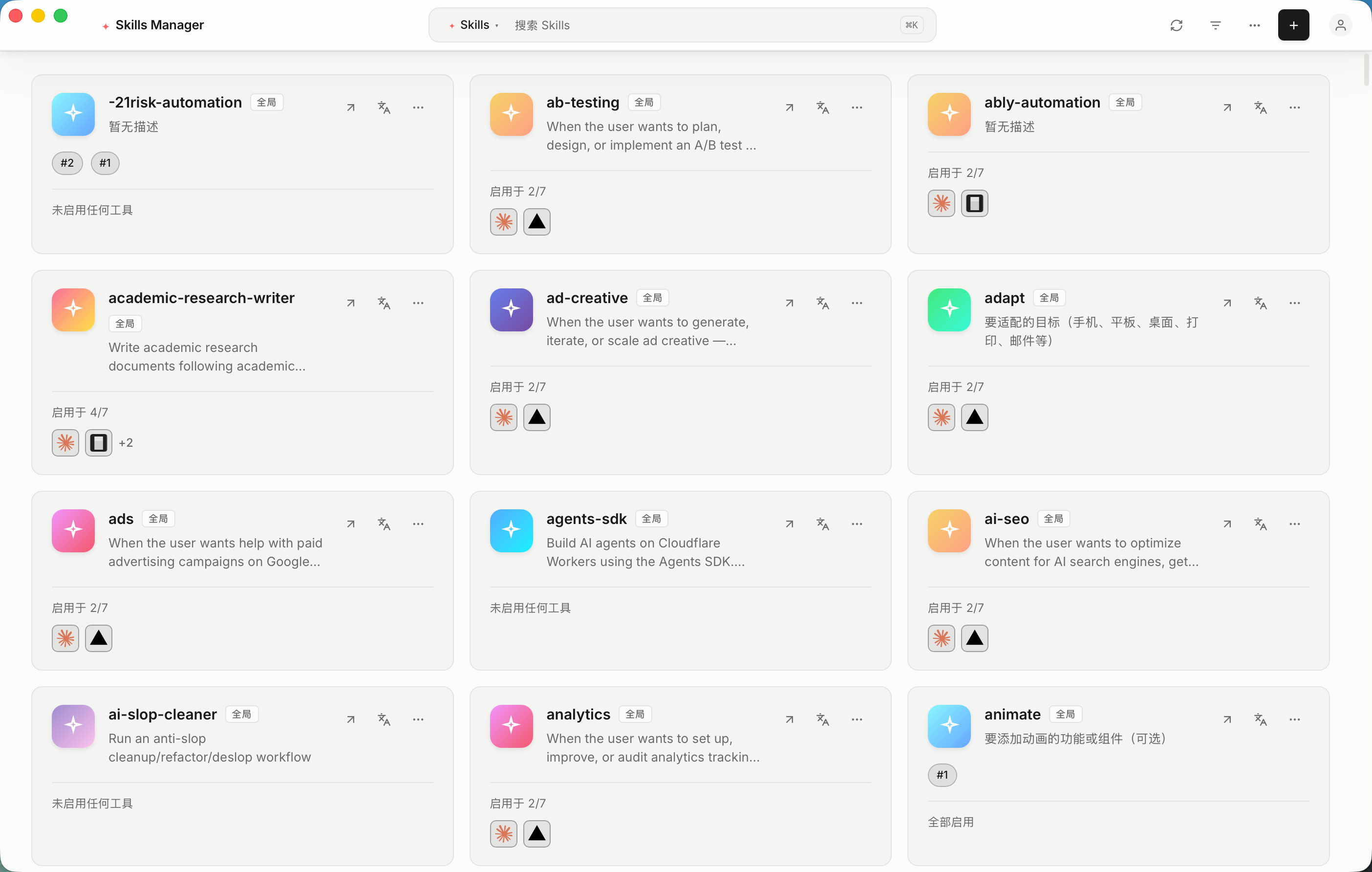
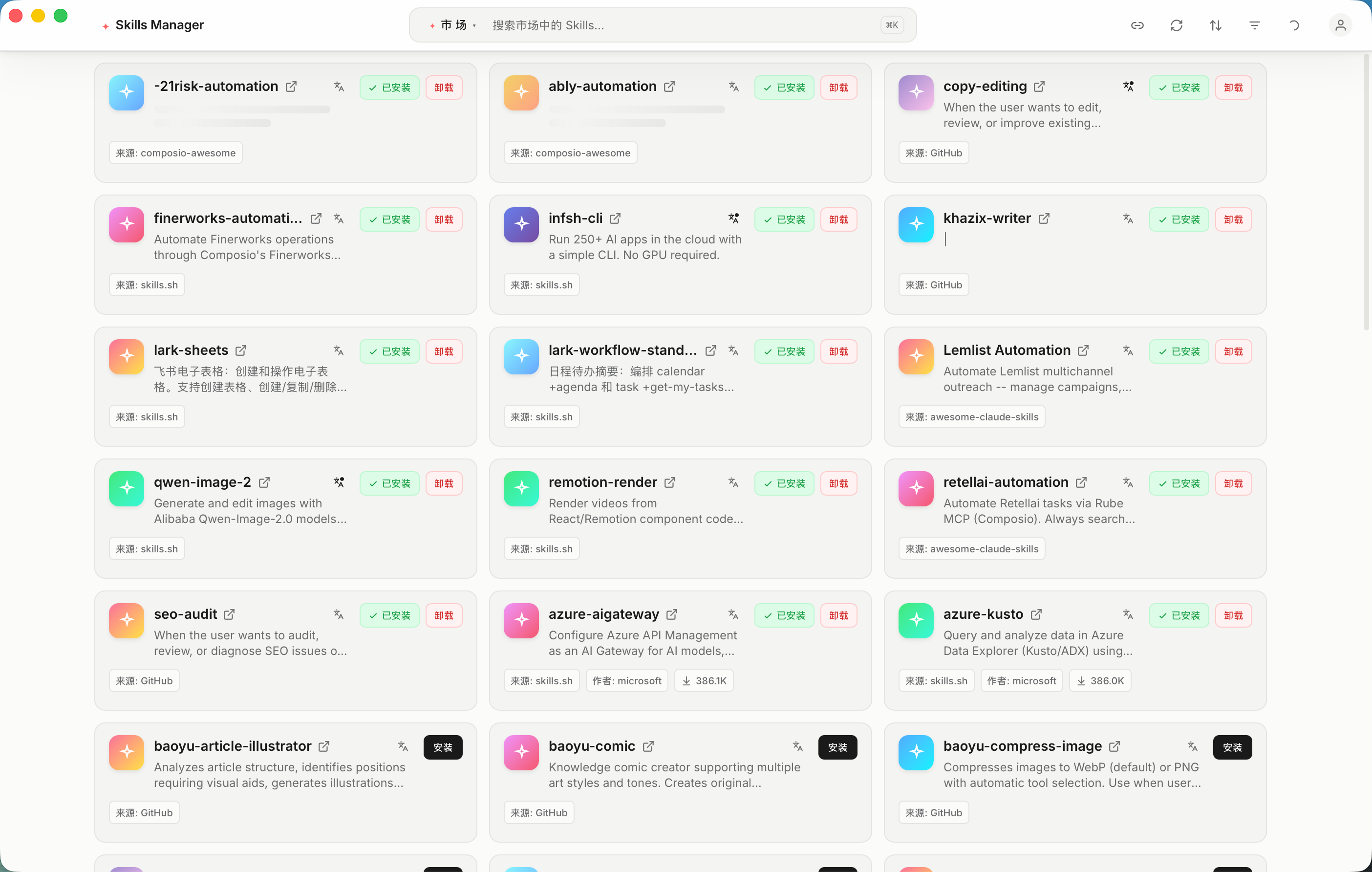
A unified desktop application for managing AI coding assistant skills. Seamlessly organize, sync, and share skills for Claude Code, Codex, Opencode and other AI tools.



Skills Manager is a modern desktop application designed to solve the fragmentation of AI assistant skills configurations. Instead of managing skills and prompts separately for different tools, Skills Manager provides a central hub.
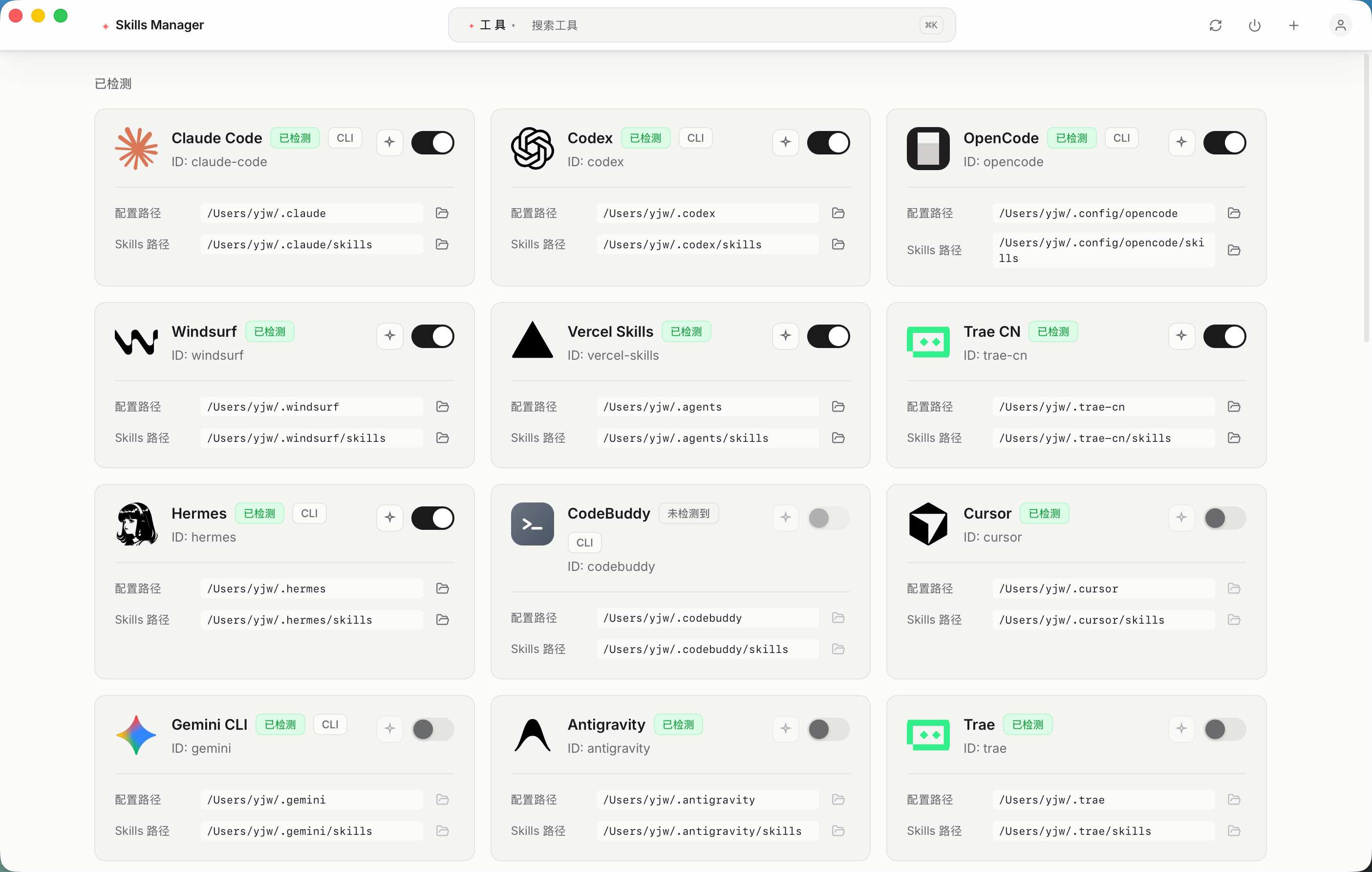
It uses a powerful symlink synchronization mechanism, allowing you to write a skill once and instantly use it across 32 supported AI tools including Claude Code, Codex, Cursor, Gemini CLI, Windsurf, Trae, and more.
⌘K / Ctrl+K.
Get the build for your platform from the official website, which detects your OS and architecture automatically, or pick a file yourself on the Releases Page.
| OS | Installer Type |
|---|---|
| macOS | .dmg — separate builds for Apple Silicon (aarch64) and Intel (x64) |
| Windows | .msi / .exe |
| Linux | .deb / .AppImage / .rpm |
brew tap jiweiyeah/tap
brew install --cask jiweiyeah/tap/skills-manager
The cask picks the right build for your CPU automatically, and brew upgrade keeps it current.
Use the full jiweiyeah/tap/skills-manager path: Homebrew's official cask repository contains an unrelated cask that happens to share the skills-manager token, and the official tap wins on a bare name.
The app is ad-hoc signed but not notarized by Apple, so the cask strips the quarantine attribute on install — see the tap README for what that means and how to opt out.
You do not need Administrator rights. When a skill is enabled for a tool, Skills Manager tries three strategies in order:
mklink /J) — the normal path on a standard account. It needs no special permission..skills-manager-source.json, so the copy stays traceable and can still be disabled from the app.A standard, non-elevated Windows account is enough for all three.
If a tool is not detected, elevation will not help either: the tool's own config directory has to exist on this machine. Check the tool compatibility matrix for the exact path each tool reads, or add it manually as a custom tool.
skm)A companion command-line tool ships with every release for terminal-first workflows: SSH/headless machines, dotfiles setup scripts, and quick status checks. It reads and writes the same config and symlinks as the desktop app, so they can be used interchangeably.
Download skm-<target>.tar.gz (.zip on Windows) from the Releases Page, extract it, and put the binary on your PATH.
skm init                          # first-run setup without the GUI (writes config, detects tools)
skm adopt [--dry-run] [--yes]     # move skills already in tool dirs into the hub and relink them
skm list [--tool <id>] [--json]   # list skills and their per-tool link status
skm enable <skill> --for <tool>   # create the symlink (e.g. skm enable ab-testing --for claude)
skm disable <skill> --for <tool>  # remove the symlink
skm doctor [--json]               # detect installed tools + report sync issues
skm fix --yes                     # repair sync issues found by doctor
Both <skill> and <tool> accept a unique prefix (claude matches claude-code). Run skm <command> --help for details. The GUI is optional: skm init + skm adopt give a fully terminal-only workflow (e.g. on headless servers).
Installing the CLI (Settings → Command Line Tool, or skm init) also copies the skills-manager-cli companion skill into the hub and enables it for every currently detected tool, so other agents can drive skm without guessing flags. It covers --json contracts, dry-run vs apply, and which commands skm does not implement.
The same companion skill is published to ClawHub automatically on every version bump, so agents that pull skills from the marketplace instead of the app always get instructions matching the current skm. The release job runs npm run publish:skill; it queries ClawHub first and only uploads when the local version is strictly newer, so re-runs are no-ops. Use npm run publish:skill -- --dry-run to validate the file list and version gate without uploading.
If you encounter a blank white screen when launching the .AppImage on Linux (especially in virtual machines like VMware/VirtualBox), it is likely a WebKitGTK hardware acceleration issue.
Please run the application from the terminal with the following command:
WEBKIT_DISABLE_COMPOSITING_MODE=1 ./Skills-Manager_<version>_amd64.AppImage
Designed for developers who care about performance and stability:
We are actively working on making Skills Manager better. Here is what we are planning:
We welcome all forms of contribution!
If this project helps you, feel free to support via QR code.
| WeChat Support QR | Alipay Support QR |
|---|---|
 |  |
Or support via Ko-fi: ko-fi.com/yeheboo
Made with ❤️ for the AI developer community.
name: skills-manager-cli
description: >
  Drive the Skills Manager CLI (`skm`) to initialize the hub, adopt unmanaged
  skills, list/enable/disable skills per AI tool, and doctor/fix symlink sync.
  Use whenever the user or an agent needs to manage skills from a terminal,
  SSH session, CI job, or headless machine; when a skill is missing in Claude
  Code, Codex, Cursor, Gemini, OpenCode, or any other supported tool; when
  asked to run skm / Skills Manager CLI; or when setting up Skills Manager
  without the GUI. Do not use for `npx skills` / skills.sh search (different
  CLI), for writing SKILL.md content (skill-creator), or for marketplace
browse/install (not in skm).skm)New here? This skill drives skm, the command-line tool that ships with
Skills Manager — a desktop app
(macOS / Windows / Linux) that installs one copy of a skill into a central hub
and symlinks it into every AI coding tool you use (Claude Code, Codex, Cursor,
Gemini, and ~30 more), so you write a skill once and it shows up everywhere.
If you found this skill on ClawHub but don't have Skills Manager yet, that is
the missing piece: skm is not a standalone binary you npm install. Get it
by installing the app from the official website
(then Settings → Command Line Tool, or run skm init), or grab a
skm-<target>.tar.gz / .zip from the
GitHub Releases page.
Source and docs: https://github.com/jiweiyeah/skills-manager.
skm is the terminal front-end of Skills Manager. It reads and writes the
same ~/.skills-manager/config.json and the same hub/tool symlinks as the
desktop app, so GUI and CLI are interchangeable.
It does not create, edit, search, translate, tag, or marketplace-install
skills. Those stay in the GUI (or you write files into the hub yourself, then
skm enable).
skm on PATH. If missing, say so and point
at install: the Skills Manager app
(Settings → Command Line Tool), or a release archive
skm-<target>.tar.gz / .zip from
GitHub Releases.
Do not fall back to npx skills — that is a different, unrelated CLI.skm --version. A stale binary from an older app release
should be updated from Settings or a matching release.init requires an initialized config. If stderr
says so, run skm init --json once — it is idempotent and will not
clobber an existing config. skm init and Settings → Install CLI also
copy this companion skill into the hub and enable it for every currently
active tool, so you usually do not need to install it by hand.Hub path is fixed at ~/.skills-manager/skills (%USERPROFILE%\.skills-manager\skills
on Windows). save() always rewrites skills_dir to that default; there is
no supported way to pick another hub from the CLI.
These exist because skm is designed to be called by agents, not just humans.
--json on init, list, doctor, fix, and adopt (apply).
Data is one JSON document on stdout. Errors go to stderr as
{"error":"..."} when the command was in JSON mode, otherwise
error: .... A command can print a result on stdout and still exit 1
(fix with failed repairs) — parse stdout, then trust the exit code.enable / disable have no --json. Success is a one-line
enabled '<id>' for '<tool>' (or disabled). Failure is error: ...
on stderr, exit 1.adopt without --yes and without --json
blocks on [y/N]. Pass --yes when applying. --json also skips the
prompt (and therefore applies) — still pass --yes so the intent is
obvious in the command line.skm adopt --json --dry-run is not a machine-readable preview: if
candidates exist it prints nothing. Preview with skm adopt --dry-run
(human text), then apply with skm adopt --yes --json.doctor --json exits 0 even when there are issues. Gate on
.issues_count, not the exit code.fix without --yes does not repair. JSON then looks like
{"applied": false, "issues_found": N, ...}. Apply with skm fix --yes --json.init, adopt, enable, disable, fix --yes) take
an advisory lock on config.json and fail fast if another skm is
mid-write. Retry once. The desktop app does not take this lock.JSON shapes, exit codes, and the dry-run/apply matrix live in
references/json.md. Read that before parsing output or writing a script.
| Intent | Command |
|---|---|
| First-run / is it initialized? | skm init --json |
| What skills exist, and where are they linked? | skm list --json |
| Same, one tool only | skm list --tool <id> --json |
| Turn a hub skill on for a tool | skm enable <skill> --for <tool> |
| Turn it off (remove the link, keep the hub copy) | skm disable <skill> --for <tool> |
| Which tools are installed, any broken links? | skm doctor --json |
| Repair what doctor reported | skm fix --yes --json |
| Preview leftover real dirs in tool skill folders | skm adopt --dry-run |
| Move those dirs into the hub and relink | skm adopt --yes --json |
<skill> and <tool> accept an exact id, an exact instance_id, or a
unique prefix (claude → claude-code). Ambiguous prefixes error and
list the matches — do not guess, rerun with a longer token. Exact tool id
wins before prefix (trae is Trae, not Trae CN). Full ids and collision
notes: references/tools.md.
command -v skm
skm init --json
skm adopt --dry-run
skm adopt --yes --json
skm list --json
skm doctor --json
init on an already-initialized config returns
{"already_initialized": true, ...} and does nothing else. If
config.json exists but cannot be parsed, init refuses to overwrite it
— move or fix the file, then retry.
skm list --json                          # find id / instance_id
skm enable <skill> --for <tool>
skm list --tool <tool> --json            # confirm enabled_for
Enabled state is derived from the link on disk, not stored as a separate
flag. enable creates the symlink (Windows: symlink → junction → tracked
copy). disable removes that link; the hub copy stays.
If the same skill id exists in both global and the active project, a bare
id is ambiguous. Use the instance_id from list: global:<id> or
project:<project_id>:<id>.
~/.skills-manager/skills/<id>/SKILL.md with YAML name +
description. A directory is a skill if it contains SKILL.md,
skill.md, or meta.json.skm enable <id> --for <tool>skm list --tool <tool> --json to confirm.Do not copy the folder into ~/.claude/skills (or any other tool dir)
yourself — that bypasses the hub and adopt will later see it as an
unmanaged real directory.
adopt looks at active tools (enabled + detected) for real
directories that are not symlinks/junctions and not hidden. It moves
each one into the hub, then puts a link back at the original path.
--dry-run), then apply (--yes --json).list should show the new ids as enabled for the source
tool.skm doctor --json
skm list --tool <tool> --json
Read the results in this order:
PATH → install, reopen the shell.config_initialized false → skm init --json.detected: false → the tool's config dir is not on this machine.
CLI does not re-detect existing tools on every call; a tool installed
after init may still show not installed until the GUI redetects or
the config is updated. Do not try to invent a custom tool from skm.enabled: false → CLI cannot flip that flag. Use the GUI Tools
page, or say so.list → it is not in the hub (and not in the active
project). Write it into the hub or adopt.enabled_for → skm enable <skill> --for <tool>.link_issues > 0 or issues_count > 0 → skm fix --yes --json. If
failed_count > 0, report the failed[].message values; do not loop
fix.enable to recreate the link over the tampered path.fix only repairs what should_report_sync_issue flags. It will not
delete a real (non-link) directory sitting in a tool's skills folder —
that is what adopt is for.
If the user named a tool, resolve it via references/tools.md and pass
--for <id>. If they did not:
| Host | --for |
|---|---|
| Claude Code | claude-code |
| Codex | codex |
| Cursor | cursor |
| Gemini CLI | gemini |
| OpenCode | opencode |
| Unsure | skm doctor --json, pick detected && enabled |
Prefix shortcuts that are unique today: claude → claude-code. Do not
use trae when the user said Trae CN (trae-cn), or qoder when they
said QoderWork CN (qoderwork-cn).
skm)| Need | What to do instead |
|---|---|
| Search / install from skills.sh | npx skills / find-skills, or the GUI Marketplace |
| Author SKILL.md | Write the file; this skill only covers linking it |
| Tags, notes, favorites, translation | GUI |
| Add/remove a custom tool, bind a project | GUI |
| Enable or disable a tool itself | GUI Tools page |
| Change the hub directory | Not supported; always ~/.skills-manager/skills |
| Marketplace publish / ClawHub | GUI |
skm is missing)The desktop app copies a bundled binary:
/usr/local/bin/skm if writable, else the first of
~/bin, ~/.local/bin that is already on PATH, else ~/.local/bin/skm
(then the folder may need to be added to PATH)skm.exe)Standalone: GitHub Releases skm-<target>.tar.gz (.zip on Windows),
extract, put on PATH.

评论 (0)
暂无评论,成为第一个评论者吧!