
复制安装命令
用 Codex 或 Claude 安装复制这段 Prompt,粘贴到 Codex、Claude 或其他助手里,让它先审查 Skill 页面再帮你安装。
复制前请先查看来源、License 和安全提示。
Persistent memory compression system built for Claude Code .
用 Codex 或 Claude 安装复制这段 Prompt,粘贴到 Codex、Claude 或其他助手里,让它先审查 Skill 页面再帮你安装。
复制前请先查看来源、License 和安全提示。
来源文件:README.md


🇨🇳 中文 • 🇹🇼 繁體中文 • 🇯🇵 日本語 • 🇵🇹 Português • 🇧🇷 Português • 🇰🇷 한국어 • 🇪🇸 Español • 🇩🇪 Deutsch • 🇫🇷 Français • 🇮🇱 עברית • 🇸🇦 العربية • 🇷🇺 Русский • 🇵🇱 Polski • 🇨🇿 Čeština • 🇳🇱 Nederlands • 🇹🇷 Türkçe • 🇺🇦 Українська • 🇻🇳 Tiếng Việt • 🇵🇭 Tagalog • 🇮🇩 Indonesia • 🇹🇭 ไทย • 🇮🇳 हिन्दी • 🇧🇩 বাংলা • 🇵🇰 اردو • 🇷🇴 Română • 🇸🇪 Svenska • 🇮🇹 Italiano • 🇬🇷 Ελληνικά • 🇭🇺 Magyar • 🇫🇮 Suomi • 🇩🇰 Dansk • 🇳🇴 Norsk





|
|
Quick Start • How It Works • Search Tools • Documentation • Configuration • Troubleshooting • License
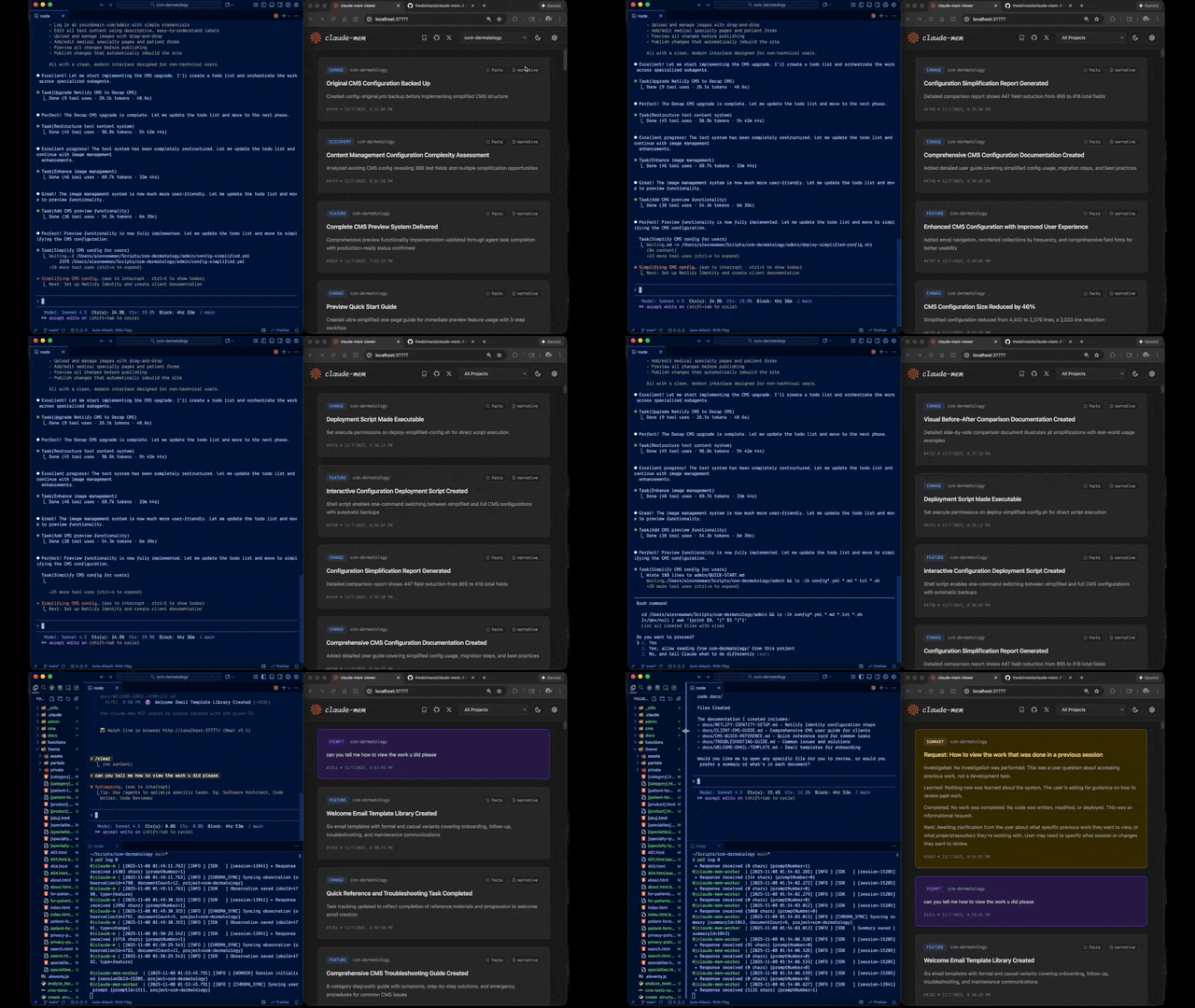
Claude-Mem seamlessly preserves context across sessions by automatically capturing tool usage observations, generating semantic summaries, and making them available to future sessions. This enables Claude to maintain continuity of knowledge about projects even after sessions end or reconnect.
Install with a single command:
npx claude-mem install
Or install for OpenCode:
npx claude-mem install --ide opencode
Or install for Antigravity CLI (setup guide):
npx claude-mem install --ide antigravity
Or install from the plugin marketplace inside Claude Code:
/plugin marketplace add thedotmack/claude-mem

/plugin install claude-mem
Restart Claude Code. Context from previous sessions will automatically appear in new sessions.
Note: Claude-Mem is also published on npm, but
npm install -g claude-meminstalls the SDK/library only — it does not register the plugin hooks or set up the worker service. Always install vianpx claude-mem installor the/plugincommands above.
Install claude-mem as a persistent memory plugin on OpenClaw gateways with a single command:
curl -fsSL https://install.cmem.ai/openclaw.sh | bash
The installer handles dependencies, plugin setup, AI provider configuration, worker startup, and optional real-time observation feeds to Telegram, Discord, Slack, and more. See the OpenClaw Integration Guide for details.
Key Features:
<private> tags to exclude sensitive content from storage📚 View Full Documentation - Browse on official website
Core Components:
See Architecture Overview for details.
Claude-Mem provides intelligent memory search through 4 MCP tools following a token-efficient 3-layer workflow pattern:
The 3-Layer Workflow:
search - Get compact index with IDs (~50-100 tokens/result)timeline - Get chronological context around interesting resultsget_observations - Fetch full details ONLY for filtered IDs (~500-1,000 tokens/result)How It Works:
search to get an index of resultstimeline to see what was happening around specific observationsget_observations to fetch full details for relevant IDsAvailable MCP Tools:
search - Search memory index with full-text queries, filters by type/date/projecttimeline - Get chronological context around a specific observation or queryget_observations - Fetch full observation details by IDs (always batch multiple IDs)Example Usage:
// Step 1: Search for index
search(query="authentication bug", type="bugfix", limit=10)

// Step 2: Review index, identify relevant IDs (e.g., #123, #456)

// Step 3: Fetch full details
get_observations(ids=[123, 456])
See Search Tools Guide for detailed examples.
Stable releases ship from main and are published to npm. core-dev and
community-edge are source-run branches for early reliability fixes and
community integrations. See Release Branches
for the branch flow and non-stable run instructions.
If you see an error like:
npm : The term 'npm' is not recognized as the name of a cmdlet
Make sure Node.js and npm are installed and added to your PATH. Download the latest Node.js installer from https://nodejs.org and restart your terminal after installation.
Settings are managed in ~/.claude-mem/settings.json (auto-created with defaults on first run). Configure AI model, worker port, data directory, log level, and context injection settings.
See the Configuration Guide for all available settings and examples.
Claude-Mem supports multiple workflow modes and languages via the CLAUDE_MEM_MODE setting.
This option controls both:
Edit your settings file at ~/.claude-mem/settings.json:
{
  "CLAUDE_MEM_MODE": "code--zh"
}
Modes are defined in plugin/modes/. To see all available modes locally:
ls ~/.claude/plugins/marketplaces/thedotmack/plugin/modes/
| Mode | Description |
|---|---|
code | Default English mode |
code--zh | Simplified Chinese mode |
code--ja | Japanese mode |
Language-specific modes follow the pattern code--[lang] where [lang] is the ISO 639-1 language code (e.g., zh for Chinese, ja for Japanese, es for Spanish).
Note:
code--zh(Simplified Chinese) is already built-in — no additional installation or plugin update is required.
See the Development Guide for build instructions, testing, and contribution workflow.
If experiencing issues, describe the problem to Claude and the troubleshoot skill will automatically diagnose and provide fixes.
See the Troubleshooting Guide for common issues and solutions.
Create comprehensive bug reports with the automated generator:
cd ~/.claude/plugins/marketplaces/thedotmack
npm run bug-report
Contributions are welcome! Please:
Claude-Mem ships from three branches: main (stable), core-dev, and
community-edge. Only main is published to npm; the others are run from
source. See Release Branches for the
strategy and local run instructions.
See Development Guide for contribution workflow.
Claude-Mem is licensed under the Apache License 2.0.
We chose Apache-2.0 because durable agentic memory should be easy to embed in developer tools, local agents, MCP servers, enterprise systems, robotics stacks, and production agent harnesses.
See the LICENSE file for full details. See docs/license.md and docs/ip-boundary.md for licensing scope and the open/commercial boundary.
Note on Ragtime: The ragtime/ directory is licensed under the Apache License 2.0. See ragtime/LICENSE for details.
Built with Claude Agent SDK | Works with Claude Code | Made with TypeScript
CMEM is a token created by a 3rd party but officially embraced by the creator of Claude-Mem (Alex Newman, @thedotmack). The token acts as a community catalyst for growth and a vehicle for bringing CMEM to the developers and knowledge workers that need it most.
Official BASE CA: 0x76b1967eec0ccaeb001bbbb2b40dc4badba31ba3
name: smart-explore
description: Token-optimized structural code search using tree-sitter AST parsing. Use instead of reading full files when you need to understand code structure, find functions, or explore a codebase efficiently.Structural code exploration using AST parsing. This skill overrides your default exploration behavior. While this skill is active, use smart_search/smart_outline/smart_unfold as your primary tools instead of Read, Grep, and Glob.
Core principle: Index first, fetch on demand. Give yourself a map of the code before loading implementation details. The question before every file read should be: "do I need to see all of this, or can I get a structural overview first?" The answer is almost always: get the map.
This skill only loads instructions. You must call the MCP tools yourself. Your next action should be one of:
smart_search(query="<topic>", path="./src")    -- discover files + symbols across a directory
smart_outline(file_path="<file>")              -- structural skeleton of one file
smart_unfold(file_path="<file>", symbol_name="<name>")  -- full source of one symbol
Do NOT run Grep, Glob, Read, or find to discover files first. smart_search walks directories, parses all code files, and returns ranked symbols in one call. It replaces the Glob → Grep → Read discovery cycle.
smart_search(query="shutdown", path="./src", max_results=15)
Returns: Ranked symbols with signatures, line numbers, match reasons, plus folded file views (~2-6k tokens)
-- Matching Symbols --
  function performGracefulShutdown (services/infrastructure/GracefulShutdown.ts:56)
  function httpShutdown (services/infrastructure/HealthMonitor.ts:92)
  method WorkerService.shutdown (services/worker-service.ts:846)

-- Folded File Views --
  services/infrastructure/GracefulShutdown.ts (7 symbols)
  services/worker-service.ts (12 symbols)
This is your discovery tool. It finds relevant files AND shows their structure. No Glob/find pre-scan needed.
Parameters:
query (string, required) -- What to search for (function name, concept, class name)path (string) -- Root directory to search (defaults to cwd)max_results (number) -- Max matching symbols, default 20, max 50file_pattern (string, optional) -- Filter to specific files/pathssmart_outline(file_path="services/worker-service.ts")
Returns: Complete structural skeleton -- all functions, classes, methods, properties, imports (~1-2k tokens per file)
Skip this step when Step 1's folded file views already provide enough structure. Most useful for files not covered by the search results.
Parameters:
file_path (string, required) -- Path to the fileReview symbols from Steps 1-2. Pick the ones you need. Unfold only those:
smart_unfold(file_path="services/worker-service.ts", symbol_name="shutdown")
Returns: Full source code of the specified symbol including JSDoc, decorators, and complete implementation (~400-2,100 tokens depending on symbol size). AST node boundaries guarantee completeness regardless of symbol size — unlike Read + agent summarization, which may truncate long methods.
Parameters:
file_path (string, required) -- Path to the file (as returned by search/outline)symbol_name (string, required) -- Name of the function/class/method to expandUse these only when smart_* tools are the wrong fit:
ensureWorkerStarted defined?")For code files over ~100 lines, prefer smart_outline + smart_unfold over Read.
Discover how a feature works (cross-cutting):
1. smart_search(query="shutdown", path="./src")
   -> 14 symbols across 7 files, full picture in one call
2. smart_unfold(file_path="services/infrastructure/GracefulShutdown.ts", symbol_name="performGracefulShutdown")
   -> See the core implementation
Navigate a large file:
1. smart_outline(file_path="services/worker-service.ts")
   -> 1,466 tokens: 12 functions, WorkerService class with 24 members
2. smart_unfold(file_path="services/worker-service.ts", symbol_name="startSessionProcessor")
   -> 1,610 tokens: the specific method you need
Total: ~3,076 tokens vs ~12,000 to Read the full file
Write documentation about code (hybrid workflow):
1. smart_search(query="feature name", path="./src")    -- discover all relevant files and symbols
2. smart_outline on key files                           -- understand structure
3. smart_unfold on important functions                  -- get implementation details
4. Read on small config/markdown/plan files             -- get non-code context
Use smart_* tools for code exploration, Read for non-code files. Mix freely.
Exploration then precision:
1. smart_search(query="session", path="./src", max_results=10)
   -> 10 ranked symbols: SessionMetadata, SessionQueueProcessor, SessionSummary...
2. Pick the relevant one, unfold it
| Approach | Tokens | Use Case |
|---|---|---|
| smart_outline | ~1,000-2,000 | "What's in this file?" |
| smart_unfold | ~400-2,100 | "Show me this function" |
| smart_search | ~2,000-6,000 | "Find all X across the codebase" |
| search + unfold | ~3,000-8,000 | End-to-end: find and read (the primary workflow) |
| Read (full file) | ~12,000+ | When you truly need everything |
| Explore agent | ~39,000-59,000 | Cross-file synthesis with narrative |
4-8x savings on file understanding (outline + unfold vs Read). 11-18x savings on codebase exploration vs Explore agent. The narrower the query, the wider the gap — a 27-line function costs 55x less to read via unfold than via an Explore agent, because the agent still reads the entire file.
Smart-explore uses tree-sitter AST parsing for structural analysis. Unsupported file types fall back to text-based search.
| Language | Extensions |
|---|---|
| JavaScript | .js, .mjs, .cjs |
| TypeScript | .ts |
| TSX / JSX | .tsx, .jsx |
| Python | .py, .pyw |
| Go | .go |
| Rust | .rs |
| Ruby | .rb |
| Java | .java |
| C | .c, .h |
| C++ | .cpp, .cc, .cxx, .hpp, .hh |
Files with unrecognized extensions are parsed as plain text — smart_search still works (grep-style), but smart_outline and smart_unfold will not extract structured symbols.
.claude-mem.json)You can register additional tree-sitter grammars for file types not in the bundled list. Create or update .claude-mem.json in your project root:
{
  "grammars": {
    "solidity": {
      "package": "tree-sitter-solidity",
      "extensions": [".sol"],
      "query": "solidity-query.scm"
    }
  }
}
Each key is a language name. package is the npm package of the tree-sitter grammar and extensions lists the file extensions it covers; the package must be installed in the project's node_modules (npm install tree-sitter-solidity). query (optional) is a path, relative to the config file, to a tree-sitter query whose captures (@func, @cls, @method, @iface, @enm, @struct_def, @imp) extract symbols. Without query, a minimal generic pattern is used — it only matches grammars that define function_declaration/class_declaration node types, and query compilation fails silently (0 symbols) for grammars that lack them, so a custom query is effectively required for most languages. Once registered, smart_outline and smart_unfold parse those extensions structurally instead of falling back to plain text.
Markdown files (.md, .mdx) receive special handling beyond the generic plain-text fallback:
smart_outline — extracts headings (#, ##, ###) as the symbol tree. Use it to navigate long documents without reading the full file.smart_search — searches within code fences as well as prose, so queries for function names inside ```ts ``` blocks work as expected.smart_unfold — expands heading sections rather than function bodies; each section up to the next same-level heading is returned as a chunk.--- delimiters) is included in smart_outline output under a synthetic frontmatter symbol so metadata like title: and description: is visible without reading the whole file.
评论 (0)
暂无评论,成为第一个评论者吧!